
With just a few strategically placed implant posts, Dr. McVety can restore an entire arch of missing teeth with implant-retained dentures — giving you the stability, chewing power, and confidence that traditional removable dentures simply can't match. Both the implants and the dentures are provided at Casco Bay Smiles in Falmouth, so your entire treatment stays under one roof.
How Implant-Retained Dentures Work
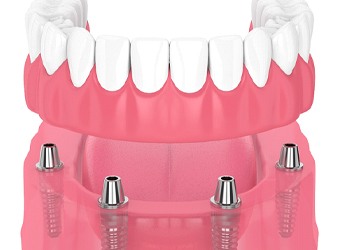
A cost-effective number of implant posts are placed at precise positions in the jawbone — typically two to four on the lower arch, four or more on the upper. Over the following three to six months, the implants fuse with the bone through a process called osseointegration, effectively becoming artificial tooth roots.
Once integration is complete, the implant tops are exposed and fitted with abutments. Your custom-made denture then snaps onto these abutments, locking firmly in place. The dentures can be designed as:
• Removable (snap-in) — you remove them for nightly cleaning, easy hygiene, and comfort • Fixed (permanently attached) — screwed in and only removable by a dentist
Benefits Over Traditional Dentures

Stability — Implant dentures don't slip, shift, or require adhesive. Improved stability means better speech and chewing power close to that of natural teeth, opening up a more varied diet.
Bone preservation — Traditional dentures accelerate jawbone loss because they don't stimulate the bone the way tooth roots do. Implants replicate that stimulation, preventing the bone shrinkage that changes facial structure over time.
Durability — The implant posts themselves can last decades — even a lifetime — with proper care. The denture prosthesis typically lasts 10–15 years before needing replacement.
No adhesive, no slipping — You'll eat, speak, and smile without worrying about your denture shifting or falling out.
Am I a Candidate?
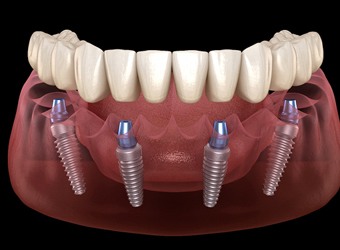
Implant-retained dentures are an excellent option if you've lost all or most of the teeth in your upper or lower jaw. Ideal candidates are in good overall health and free of active gum disease.
If bone loss has already occurred — common with long-term denture wear — a bone grafting procedure may be needed first to rebuild the density required to support the implant posts. Dr. McVety will evaluate your bone volume with 3D imaging during your consultation.
We'll also screen for gum disease before any surgical steps; periodontal health is a prerequisite for successful implant integration.
The Treatment Process
Getting implant-retained dentures takes place across several appointments over a few months:
1. Consultation & imaging — 3D CBCT scan, candidacy evaluation, and custom treatment plan 2. Bone grafting (if needed) — rebuild jawbone density; healing takes 3–6 months 3. Implant placement — small incisions expose the bone; posts are placed and gums are sutured 4. Osseointegration — 3–6 months for implants to fuse fully with the jawbone 5. Abutment placement — implant tops are uncovered and fitted with connector pieces 6. Denture fitting — your custom prosthetic snaps onto the abutments
Dr. McVety uses advanced 3D scanning technology throughout to ensure precise placement and a comfortable, well-fitting result.